Precautional Seeds Axis (2026 - 2027)
Keywords: Seeded Memory, Sacred Commodification & Whispers of Ancestry
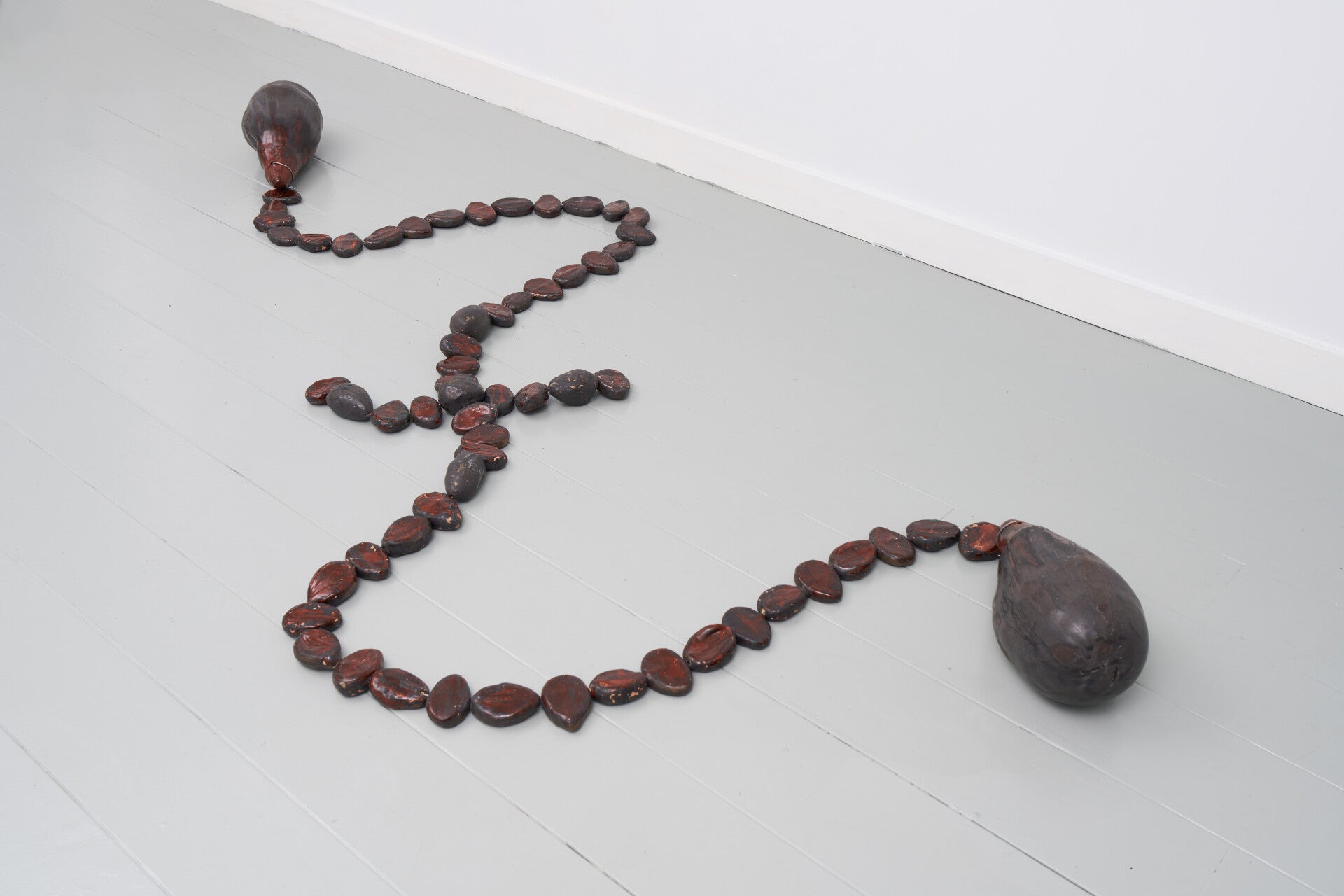
The Guapuruvu Double Pendulum 2026 - A floor-based ceramic sculpture of 500cm, composed of 60 ceramic Guapuruvu seeds and two glazed pendulums, each measuring 35 cm in length.
The Guapuruvu can grow up to three metres per year and develops very few side branches during its early stages. This distinctive upward growth has led to its association with the “Reach-for-the-Sky Tree.” In Christian interpretations, its direct vertical growth has been understood as a metaphor for a steadfast path towards God. Conceived specifically to be presented on the ground, the sculpture unfolds as an elongated, river-like form that suggests a landscape in constant motion and transformation. Its flowing structure is informed by a mathematical approach to observing nature, bringing systems of measurement, balance, and opposition into a physical form. The overall composition draws on the structure of a double pendulum—a dynamic system in which movement develops through the interaction between action and reaction, order and unpredictability. At the centre of the sculpture is a yellow, flower-like form referencing a plant that remains in perpetual bloom. Acting as a visual anchor within the elongated composition, the flower introduces a sense of continuity and renewal, suggesting resilience and the persistent capacity of life to regenerate. A central source of inspiration for the work is the Guapuruvu tree, a species native to Brazil and known for its extraordinary rate of growth. Within agroforestry systems, the tree is associated with strength, prosperity, protection, and good fortune. Across communities from Brazil to Mexico, it has also come to represent aspiration, hope, and faith. Beyond its symbolic significance, the Guapuruvu plays an important ecological role as a pioneer species. It is among the first trees to establish itself on damaged or barren land. By rapidly creating shade and improving the surrounding conditions, it allows more vulnerable species to take root and eventually flourish. The tree therefore becomes a metaphor for regeneration and collective growth: although its own lifespan is relatively short, its presence creates the conditions from which an entire forest can emerge.

Installation view at Art Rotterdam 2026, presented with Josilda da Conceição Gallery
In Amazonian traditions, certain seeds are valued not only for their natural beauty, but for their spiritual potency. These seeds are often used in spells and protective practices, where they function as carriers of intention and energy. Worn on the body, kept in small bundles, or placed within the home, they are believed to guard against harm, deflect negative forces, and attract balance and well-being. The use of seeds in ritual contexts is deeply connected to the relationship between humans and the natural world. Rather than passive objects, these seeds are understood as living elements—imbued with the soul of the forest and the memory of the land. Through touch, repetition, and belief, they become activated as tools of protection and transformation. Gifting these seeds is a meaningful act within many communities. To offer a seed is to offer care, protection, and good fortune. It establishes a bond between giver and receiver, extending the protective field beyond the individual into a shared space of trust and connection. In this sense, the seed becomes both an object and a gesture—material and symbolic at once. Whether used in ritual, worn as an amulet, or exchanged as a gift, Amazonian seeds embody a continuity of knowledge and belief. They carry with them histories of protection, healing, and resilience, remaining active participants in both traditional practices and contemporary reinterpretations.

Péndulo Ojo de Buey (2026) 40 ceramic seeds, 8 ceramic sand–coated Nails, 1 ceramic pendulum drop of water, installation of 380 cm

Close-up of the sculpture, Péndulo Ojo de Buey (2026) — 40 ceramic seeds, 8 ceramic sand–coated nails, 1 ceramic pendulum drop, installation with 380 cm of water.
Inspired by ojo de buey, a South American protection seed traditionally carried as an amulet against misfortune, this work unfolds as a suspended, rhythmic system of balance and tension. The ceramic elements—seeds, needles, and pendulum—are arranged in a vertical composition that oscillates between stillness and potential movement, evoking both ritual precision and fragility. The repeated seed forms function as symbolic carriers of protection and continuity, while the elongated, sand-textured needles suggest acts of piercing, marking, or channeling unseen forces. At the center, the pendulum drop becomes an axis of orientation, recalling systems of divination and the search for equilibrium between material and spiritual realms. The presence of water introduces a reflective and temporal dimension, amplifying the work’s sensitivity to motion, gravity, and change. By translating an organic talisman into ceramic, the installation preserves and recontextualizes its protective function, transforming it into a contemplative structure. The work reflects on how objects migrate across contexts—shifting from intimate amulets to monumental forms—while retaining their symbolic charge as vessels of belief, protection, and transformation.

Close-up of Huayruro Protocol (2026) — Detail of a wall-mounted ceramic sculpture featuring huayruro forms, alongside ceramic scissors.

Huayruro Protocol (2026) — A wall-mounted ceramic sculpture consisting of 29 male and 29 female huayruro forms, combined with 10 ceramic scissors finished with sand and glaze, extending to a total length of 250 cm.
Huayruro Worship - The huayruro seed, known scientifically as Ormosia coccinea, holds a profound place within Andean and Amazonian cosmologies, where it is revered not merely as a natural object, but as a living vessel of protection and balance. Recognizable by its striking red and black coloration, the seed embodies a dual symbolism: red as life force, vitality, and abundance; black as protection, grounding, and the deflection of negative energies. This chromatic pairing reflects a broader worldview rooted in duality, where harmony emerges through the coexistence of opposing forces. Traditionally, huayruro seeds are carried as amulets, often in paired forms—understood as male and female—to activate their full protective potential. Worn on the body, placed in the home, or embedded within ritual objects, they function as guardians against misfortune, envy, and spiritual imbalance. Their presence is believed to attract prosperity while maintaining a protective boundary between the individual and unseen forces. Beyond their symbolic role, huayruros are deeply embedded in ritual practice. They are frequently combined with other natural elements—plants, fibers, or minerals—forming assemblages that connect the human body to the soul and to ancestral knowledge systems. In this sense, the seed operates not only as an object of belief, but as a mediator between material and spiritual realms.